
The deeper I get into understanding AI, the less it looks like a software story alone. Increasingly, it looks like an industrial system.
At first glance, the AI stack seems familiar: models, applications, agents, and the software businesses being built around them. But move down a few layers and the picture changes.
Behind the model is compute. Behind compute are data centers. Behind data centers are power, cooling, networking, land, and supply chains. Move in the other direction and the dependencies continue: enterprise data, security, governance, applications, workflows, people—and eventually economic value.
That is what makes AI interesting beyond any individual model.
The system is layered, interdependent, and constrained.
And the constraint can move.
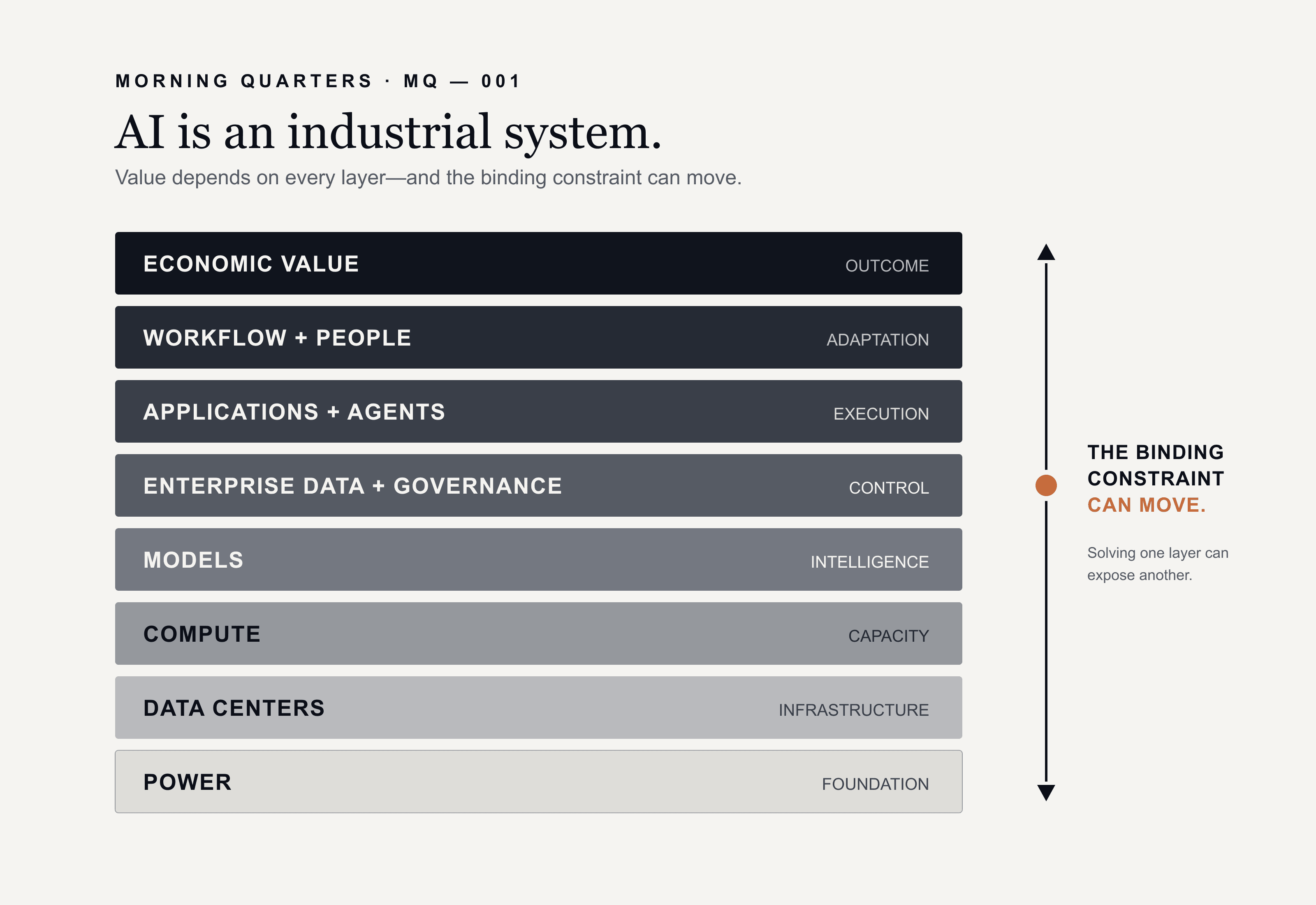
If compute is scarce, GPUs matter most. Add enough compute and power can become the limiting factor. Solve infrastructure problems and the constraint may move to proprietary data, security, governance, or integration. Solve those, and an organization may discover that the harder problem is changing how work gets done.
We can already see this at both ends of the system.
The IEA expects global data-center electricity consumption to reach roughly 945 TWh by 2030—slightly more than Japan consumes today. AI is expected to be the largest driver of that growth.
Inside the enterprise, the problem looks different. AI adoption is already widespread, but enterprise-scale transformation is not. McKinsey found that nearly two-thirds of organizations have not yet begun scaling AI across the enterprise. Its research also found workflow redesign to be the organizational factor with the greatest effect on whether companies see EBIT impact from generative AI.
That distinction matters.
Scaling AI is not one transformation. It is a series of smaller transformations across the organization.
A business unit may need to redesign a workflow. Security teams may need new controls. Data architecture may need to change. Governance may need to account for new risks. Employees may need to learn how to work differently. Leadership may need to change incentives, processes, or decision rights.
Solving one constraint, then, does not solve the system. It changes the system—and can expose or create another constraint somewhere else.
For the C-suite, that means AI cannot be treated as another isolated software budget. Infrastructure, data, governance, workflow, talent, and organizational design increasingly have to be considered together.
For the AE or SE, the implication is just as important. Product knowledge matters, but understanding where the customer is actually constrained may matter more. The best discovery may be less about what technology a company wants to buy and more about what is preventing the system from producing the outcome it wants.
That is the larger takeaway.
AI adoption is not a single deployment. It is repeated organizational adaptation across technology, process, governance, and people.
The organizations that create the most value may not be the ones with access to the best model.
They may be the ones that can identify where the constraint has moved—and reorganize around it fastest.
Sources
International Energy Agency — Energy and AI
McKinsey — The state of AI in 2025
McKinsey — The state of AI: How organizations are rewiring to capture value
Morning Quarters
John Reichert